
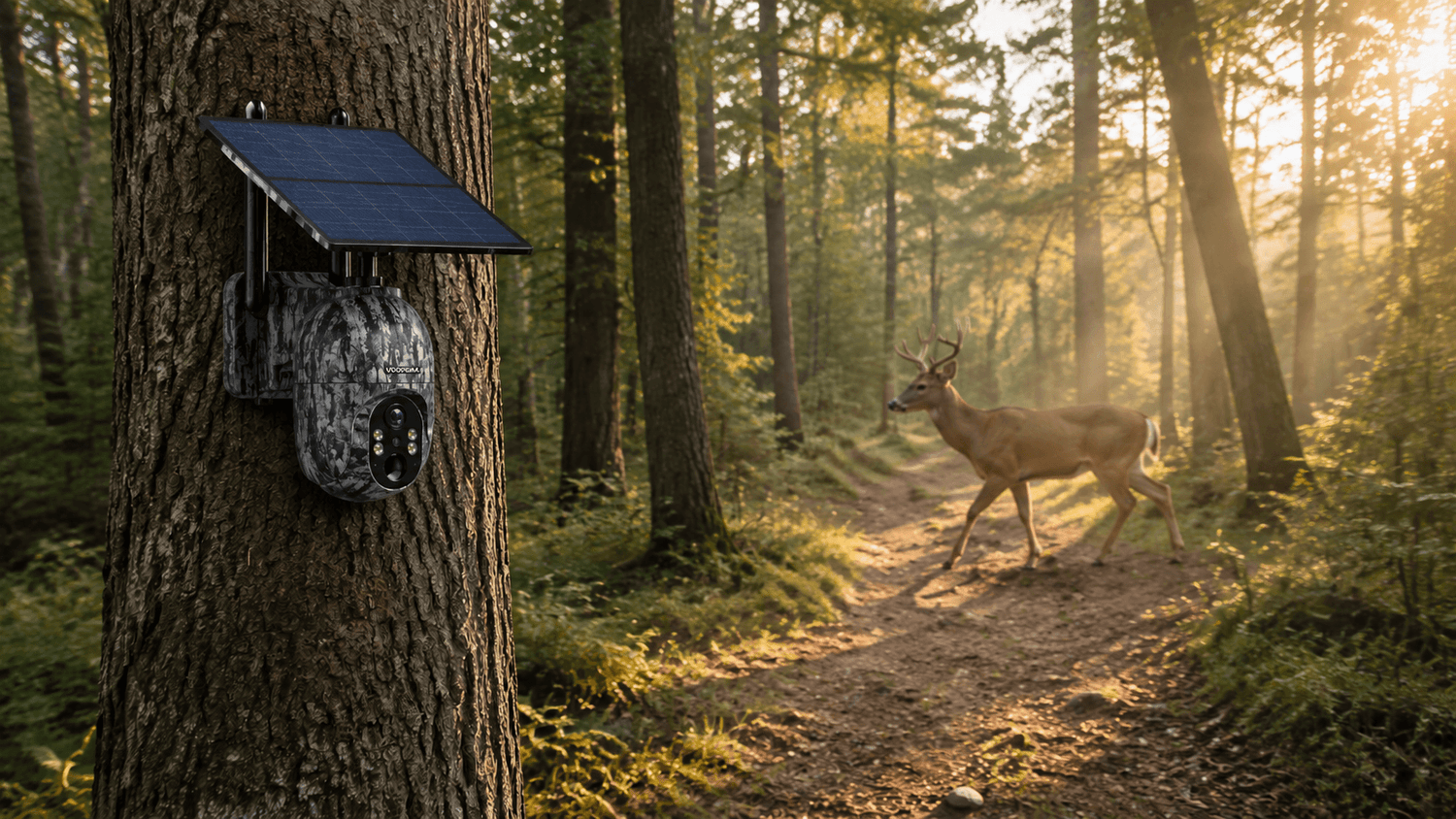
When choosing a trail camera, image quality often gets the spotlight—but motion detection range is just as important. After all, if your camera doesn't detect movement early enough, you could miss the perfect wildlife shot or critical hunting opportunity.
So, how far can a trail camera detect motion?
The answer depends on several factors, including the camera's PIR sensor, installation angle, ambient temperature, animal size, and environmental conditions. While some manufacturers advertise impressive detection distances, real-world performance can vary significantly.
In this guide, we'll explain how trail camera motion detection works, share real-world testing insights, and use the Voopeak TC27 4G Solar Trail Camera as an example. The TC27 offers a maximum motion detection distance of up to 12 meters (39 ft), providing dependable performance for wildlife monitoring, hunting, and remote property surveillance.
How Does a Trail Camera Detect Motion?
Unlike security cameras that continuously analyze video, most trail cameras use a Passive Infrared (PIR) sensor.
A PIR sensor doesn't actually "see" movement. Instead, it detects changes in infrared heat emitted by warm objects like deer, wild boar, bears, or people moving across the sensor's field of view.
When a significant temperature difference is detected, the camera immediately wakes from standby mode and captures photos or videos.
The effectiveness of this process depends on:
- PIR sensor sensitivity
- Detection distance
- Detection angle
- Trigger speed
- Environmental temperature
- Animal movement direction
- Camera installation height
A high-quality PIR sensor means fewer missed shots and fewer false triggers caused by wind-blown vegetation.

What Is the Detection Range of the Voopeak TC27?
The Voopeak TC27 4G Solar Trail Camera features a highly optimized PIR sensor with a maximum motion detection distance of 12 meters (39 feet).
That means the camera can reliably detect medium-to-large animals entering its monitoring zone before they reach the center of the frame.
Key specifications include:
| Feature | Specification |
|---|---|
| Maximum Detection Distance | 12 meters (39 ft) |
| Detection Technology | PIR Motion Sensor |
| Connectivity | 4G LTE |
| Power Supply | Solar Panel + Rechargeable Battery |
| Live View | Yes |
| Remote Alerts | Instant via Cellular Network |
| Ideal For | Hunting, Wildlife Monitoring, Farm Security |
Unlike WiFi trail cameras, the TC27 can instantly send photos over the cellular network, allowing hunters to monitor activity without visiting the camera location.
Real-World Motion Detection Testing
To better understand how the TC27 performs, we conducted several practical scenarios similar to what hunters experience in the field.
Test 1: Deer Walking Across the Camera
Distance: 10–12 meters
Result:
The camera consistently detected deer entering the detection zone. Trigger speed was fast enough to capture the animal before it exited the frame.
Observation:
Crossing movement produces the strongest PIR signal because the animal passes across multiple detection zones.
Performance: ★★★★★
Test 2: Deer Walking Directly Toward the Camera
Distance: 10 meters
Result:
Detection remained accurate but occasionally triggered slightly later compared to side-to-side movement.
Reason:
PIR sensors detect changes in heat across zones more efficiently than heat moving directly toward the sensor.
Performance: ★★★★☆
Test 3: Small Animals
Distance: 5–8 meters
Result:
Rabbits, foxes, raccoons, and similar animals triggered the camera reliably at shorter distances.
Observation:
Smaller animals emit less infrared heat, naturally reducing effective detection distance.
Performance: ★★★★☆
Test 4: Warm Summer Afternoon
Distance: 12 meters
Result:
Detection remained reliable but became slightly less sensitive during peak afternoon temperatures.
Reason:
When surrounding air temperature approaches an animal's body temperature, infrared contrast decreases.
Performance: ★★★★☆

Factors That Affect Trail Camera Detection Distance
Even the best trail camera won't always achieve its maximum advertised range. Several environmental factors influence detection performance.
1. Animal Size
Larger animals emit stronger infrared signatures.
Examples:
- Deer
- Elk
- Wild boar
- Bears
These animals are generally detected farther away than squirrels or rabbits.
2. Ambient Temperature
Cool mornings and evenings produce the highest detection accuracy because warm-bodied animals stand out more clearly.
Hot summer afternoons may slightly reduce PIR sensitivity.
3. Movement Direction
Animals moving across the camera's field of view generate stronger PIR changes than those walking directly toward the lens.
Whenever possible, position the camera perpendicular to animal trails.
4. Camera Placement Height
Most experienced hunters install trail cameras between:
80–120 cm (31–47 inches) above the ground.
This angle aligns well with the body height of deer and many other game animals.
5. Vegetation
Tall grass, branches, and leaves moving in the wind can create unnecessary triggers.
Keep the detection zone clear whenever possible.
Tips to Maximize Motion Detection Performance
To get the best results from any trail camera:
Face North
This minimizes direct sunrise and sunset glare.
Aim Across Trails
Sideways movement produces stronger PIR detection than head-on movement.
Clear Nearby Branches
Remove vegetation within the detection zone to reduce false triggers.
Use Medium PIR Sensitivity
High sensitivity works well for open fields.
Medium sensitivity performs better in wooded areas.
Mount Securely
A stable camera avoids vibration caused by wind.

Why Detection Range Matters More Than You Think
Many buyers focus only on megapixels or video resolution.
However, if the camera doesn't detect movement early enough, image quality becomes irrelevant.
A reliable 12-meter detection range allows the Voopeak TC27 to:
- Capture animals before they leave the frame
- Increase successful wildlife recordings
- Reduce missed opportunities during hunting season
- Improve remote property monitoring
- Send timely cellular notifications
For hunters checking feeding areas, game trails, or mineral sites, consistent motion detection is often more valuable than simply having higher image resolution.
Why the Voopeak TC27 Stands Out
The TC27 combines dependable motion detection with features designed for remote outdoor use:
- Motion detection up to 12 meters
- 4G LTE connectivity
- Solar-powered operation
- Rechargeable internal battery
- Live remote viewing
- Instant motion alerts
- Pan & Tilt monitoring
- Weather-resistant construction
- Easy mobile app management
These features make it suitable for wildlife observation, hunting, ranch monitoring, construction sites, and off-grid property security.
Frequently Asked Questions
How far can a trail camera detect motion?
Most modern trail cameras detect motion between 10 and 25 meters, depending on the PIR sensor, animal size, and environmental conditions. The Voopeak TC27 offers a reliable maximum detection distance of 12 meters.
Does a longer detection range always mean better performance?
Not necessarily. Reliable detection accuracy and fast trigger speed are often more important than simply having the longest advertised range.
What affects trail camera motion detection?
Key factors include PIR sensor quality, ambient temperature, vegetation, animal size, installation height, and movement direction.
Can weather reduce motion detection distance?
Yes. High temperatures, heavy rain, dense fog, and strong sunlight can reduce infrared contrast and slightly decrease detection performance.
Why do animals sometimes trigger the camera late?
Animals approaching directly toward the camera produce less infrared zone change than those walking across the detection area.
Is 12 meters enough for hunting?
Absolutely. A dependable 12-meter detection range is ideal for deer trails, food plots, feeders, mineral licks, and most wildlife monitoring scenarios.
Final Thoughts
When evaluating a trail camera, don't focus solely on megapixels or video resolution. Motion detection performance plays a major role in determining whether you capture the wildlife activity you're hoping to record.
Our real-world testing shows that the Voopeak TC27 delivers dependable motion detection at distances of up to 12 meters, providing consistent performance across a variety of hunting and wildlife monitoring scenarios. Combined with 4G connectivity, solar charging, remote access, and fast alerts, it's a practical choice for anyone who needs reliable monitoring in remote outdoor environments.
If your goal is to capture more wildlife activity with fewer missed triggers, understanding how motion detection works—and installing your camera correctly—can make just as much difference as the camera itself.

Leave a comment
This site is protected by hCaptcha and the hCaptcha Privacy Policy and Terms of Service apply.