
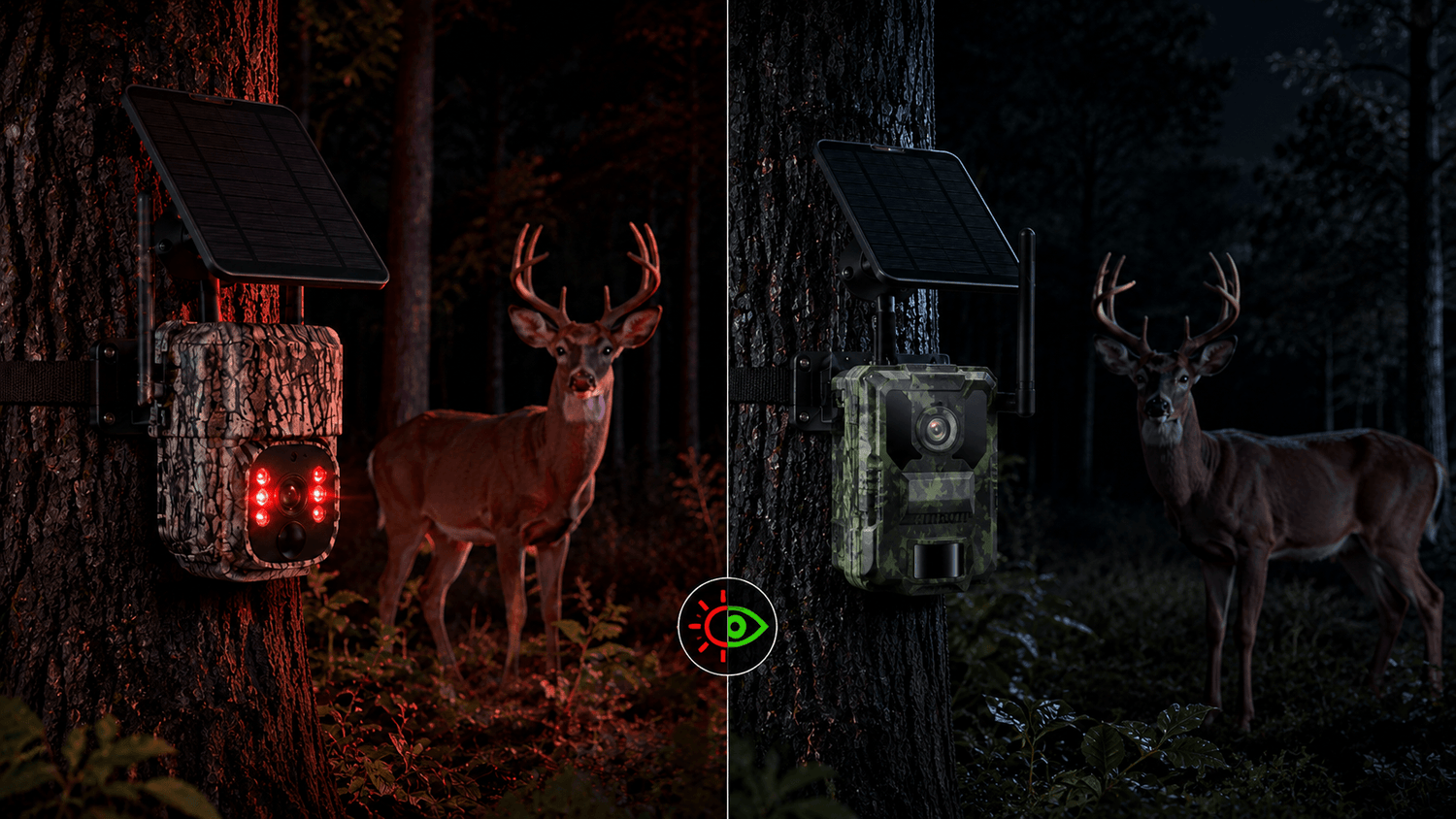
Night vision is one of the most important features in modern trail cameras, especially for hunters and wildlife observers who need to capture animal activity after dark. Since most wildlife is active at night, understanding how trail camera night vision works can help you choose the right camera for your environment.
There are two main technologies used in night vision trail cameras:
- Infrared (Low Glow) Night Vision
- No Glow (Black Flash / Invisible IR) Night Vision
Each has different advantages depending on how and where you use your camera.
In this guide, we break down both technologies and explain why models like the Voopeak TC36 No Glow Trail Camera are ideal for stealth wildlife monitoring.
What Is Trail Camera Night Vision?
Trail camera night vision refers to the ability of a camera to capture images or video in low-light or completely dark environments using infrared technology.
Unlike normal cameras that rely on visible light, trail cameras use infrared LEDs to illuminate the scene without disturbing wildlife.
This allows you to monitor:
- Deer trails
- Hunting zones
- Wildlife feeding areas
- Farm perimeters
- Remote property boundaries
How Infrared (Low Glow) Night Vision Works
Infrared night vision uses 850nm IR LEDs, which emit a faint red glow when activated.
Key Features:
- Slight visible red glow
- Longer illumination range
- Lower cost
- Good image brightness at night
When motion is detected, the IR LEDs turn on and light up the scene for the camera sensor.
Pros:
- Stronger night image brightness
- Longer detection range
- More affordable option
Cons:
- Visible red glow can be seen by animals
- May slightly disturb sensitive wildlife
- Easier for humans to detect camera location
Infrared cameras are ideal for general wildlife monitoring where stealth is not the highest priority.

What Is No Glow (Black Flash) Night Vision?
No Glow trail cameras use 940nm infrared LEDs, which are completely invisible to both humans and animals.
This is also called:
- Black Flash technology
- Invisible IR night vision
- Stealth night vision
A good example is the Voopeak TC36 No Glow Trail Camera, designed specifically for hidden wildlife observation.
How No Glow Technology Works
Instead of emitting visible red light, the camera uses:
- Invisible infrared illumination
- Highly sensitive image sensors
- Low-light enhancement processing
This allows the camera to record wildlife without being detected.
Advantages of No Glow Cameras:
- Completely invisible at night
- Ideal for shy wildlife (deer, fox, boar)
- Perfect for security monitoring
- No light pollution or disturbance
Limitations:
- Slightly shorter illumination range than low glow
- More expensive due to advanced LEDs
- Requires better sensor quality for clarity

Infrared vs No Glow: Key Differences
| Feature | Infrared (Low Glow) | No Glow (Black Flash) |
|---|---|---|
| Light Visibility | Visible red glow | Completely invisible |
| Wildlife Disturbance | Medium | Very low |
| Night Image Brightness | Higher | Slightly lower |
| Stealth Level | Low | Very high |
| Cost | Lower | Higher |
| Best Use | General monitoring | Stealth wildlife + security |
Why No Glow Cameras Like Voopeak TC36 Matter
The Voopeak TC36 No Glow Trail Camera is designed for users who need maximum stealth in nighttime environments.
It is especially useful for:
- Deer hunting setups
- Wildlife research
- Farm security
- Property monitoring in remote areas
Because it uses black flash technology, animals cannot detect the camera at all—even at close range.
This significantly improves:
- Natural animal behavior capture
- Hunting success rates
- Security effectiveness
Real-World Night Vision Performance
In real outdoor environments, night vision performance depends on:
1. Distance
Infrared cameras typically perform better at longer ranges, while no glow cameras prioritize stealth over extreme distance.
2. Weather Conditions
Fog, rain, and humidity can reduce IR clarity, especially in dense forests.
3. Animal Behavior
Some animals are sensitive to visible IR light, which can affect movement patterns.
No glow cameras eliminate this issue entirely.
4. Placement Angle
Correct positioning improves night image clarity and reduces motion blur.
When Should You Choose Infrared vs No Glow?
Choose Infrared (Low Glow) If:
- You need longer night range
- Budget is a priority
- Wildlife disturbance is not critical
- You are monitoring open fields
Choose No Glow (TC36) If:
- Stealth is important
- You monitor deer or shy wildlife
- You need hidden security surveillance
- You want zero visible light at night
Why Night Vision Matters for Trail Cameras
Without night vision, most wildlife activity would be missed entirely.
Night vision enables:
- 24-hour wildlife tracking (event-based, motion-triggered)
- Better hunting strategy planning
- Property security after dark
- Behavioral analysis of animals
For hunters and outdoor users, night vision is not optional—it is essential.
Why Voopeak Trail Cameras Stand Out
Voopeak trail cameras are designed for:
- High sensitivity PIR motion detection
- Advanced infrared night vision systems
- Low power consumption
- Reliable outdoor durability
- Flexible deployment in remote environments
Models like the TC36 No Glow are especially strong in stealth scenarios, while other Voopeak models offer long-range infrared performance.
Frequently Asked Questions
What is the difference between infrared and no glow trail cameras?
Infrared cameras emit a faint red glow at night, while no glow cameras use invisible infrared light that cannot be seen by animals or humans.
Is no glow better for deer hunting?
Yes. No glow cameras like the Voopeak TC36 are ideal for deer hunting because they do not disturb animal behavior.
Do no glow cameras have worse image quality?
Slightly in some conditions, but modern sensors minimize the difference significantly.
Can animals see infrared trail cameras?
Animals may see the faint red glow from low glow infrared LEDs, but cannot see no glow (940nm) cameras.
Are no glow trail cameras worth it?
Yes, especially for stealth wildlife monitoring, hunting setups, and security applications where invisibility is important.

Final Thoughts
Trail camera night vision technology plays a critical role in capturing accurate wildlife behavior after dark.
Infrared (low glow) cameras offer stronger brightness and longer range, while no glow cameras like the Voopeak TC36 provide unmatched stealth and invisibility.
Choosing between them depends on your priority: image brightness vs total concealment.
For serious wildlife observation or hunting applications, no glow technology is often the preferred choice due to its ability to capture natural animal behavior without interference.

Leave a comment
This site is protected by hCaptcha and the hCaptcha Privacy Policy and Terms of Service apply.