
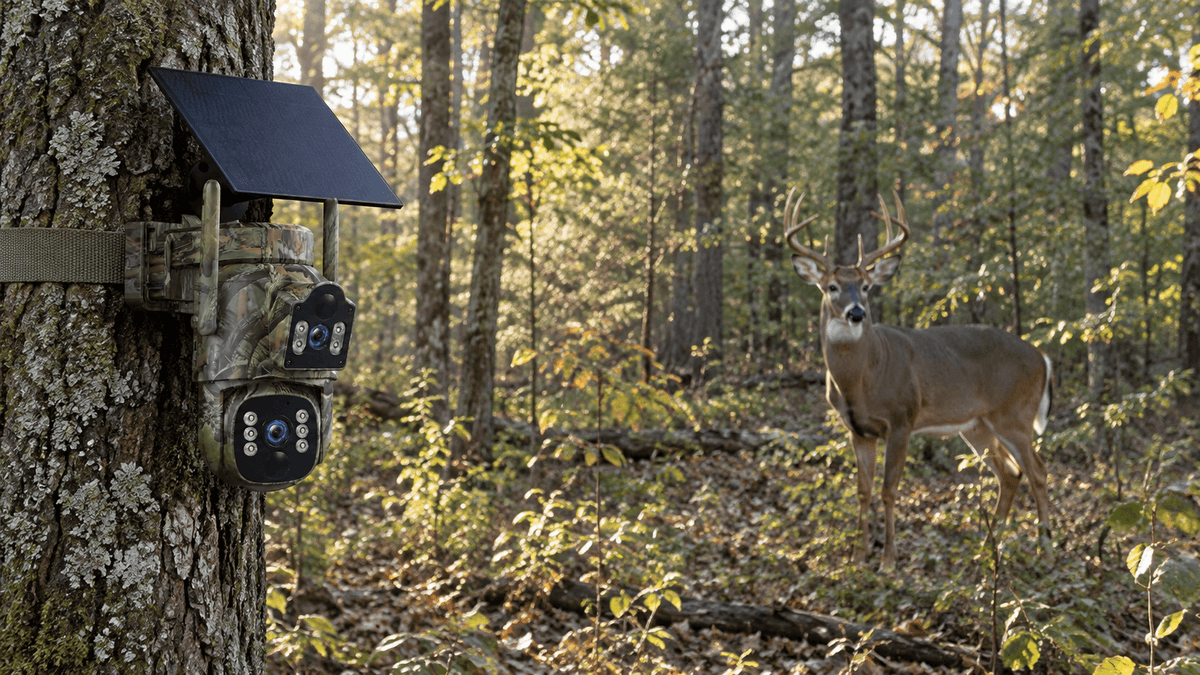
If you are setting up a trail camera for deer, wildlife, hunting, property security, or outdoor monitoring, one of the most important questions is: how far can a trail camera detect motion?
For many modern trail cameras, a practical motion detection distance is around 10 meters (33 feet), although the actual range can vary depending on the camera model, PIR motion sensor, animal size, movement direction, weather conditions, terrain, and camera placement.
Understanding trail camera detection range can help you choose the right location, reduce missed wildlife activity, and capture more useful photos and videos.
In this guide, we will explain how trail camera motion detection works, how far a trail camera can detect movement, what affects detection distance, and how to position a Voopeak trail camera for better wildlife monitoring.
How Far Can a Trail Camera Detect Motion?
A typical modern trail camera can detect movement from approximately 10 meters (33 feet) away under suitable outdoor conditions.
However, this number should be treated as a practical reference rather than a universal limit. Some trail cameras may detect movement at shorter or longer distances depending on their PIR sensor, lens design, sensitivity settings, environmental conditions, and the size of the moving subject.
For example, a large deer walking across the camera's detection zone may be detected from farther away than a small animal such as a rabbit or squirrel.
The direction of movement also matters. A subject moving across the camera's field of view is generally easier for a PIR sensor to detect than an animal walking directly toward or away from the camera.
For this reason, when installing a trail camera, simply knowing the maximum detection range is not enough. Camera placement is just as important as sensor distance.
Quick Reference: Trail Camera Detection Distance
| Distance | Approximate Use |
|---|---|
| 3–5 meters | Close-range wildlife and feeding areas |
| 5–8 meters | General wildlife monitoring |
| Around 10 meters / 33 feet | Common practical detection range |
| 10+ meters | Possible with suitable camera and conditions, but performance varies |
For most hunting and wildlife applications, positioning the camera approximately 5–10 meters from the area you want to monitor can provide a useful balance between motion detection and image quality.
What Is a Trail Camera Motion Detection Range?
The motion detection range of a trail camera refers to the distance at which its motion sensor can recognize a moving or temperature-changing subject and trigger the camera.
This is different from the camera's photo or video viewing range.
A trail camera may have a wide-angle lens that can capture a large area, but the PIR sensor determines whether movement within that area actually triggers the camera.
This distinction is important when comparing trail cameras.
For example:
- Detection range = how far the motion sensor can detect a subject.
- Detection angle = how wide the motion sensor's detection area is.
- Trigger speed = how quickly the camera takes a photo or starts recording after detecting movement.
- Camera field of view = how much of the scene the lens can capture.
- Night vision range = how far the camera can illuminate and record a subject in darkness.
These specifications work together to determine how effectively a trail camera monitors wildlife.
How Does a Trail Camera Detect Motion?
Most trail cameras use a PIR sensor, which stands for Passive Infrared sensor.
A PIR sensor detects changes in infrared radiation, which is closely related to heat. When a warm object such as a deer, fox, raccoon, or person moves through the sensor's detection area, the change can trigger the camera.
This is why trail cameras are especially useful for wildlife monitoring.
Unlike a conventional security camera that may continuously record, a trail camera can remain in a low-power standby mode and activate when movement is detected. This helps conserve battery power and storage space.
The effectiveness of the PIR sensor depends on several factors, including:
- Distance from the subject
- Size of the animal
- Direction of movement
- Temperature difference between the animal and surroundings
- Vegetation and obstacles
- Sensor sensitivity
- Weather conditions
- Camera installation height and angle
Therefore, a manufacturer's stated detection distance should be viewed as a reference under suitable conditions rather than a guarantee for every environment.
Does Movement Direction Affect Detection Distance?
Yes. Movement direction can have a significant impact on trail camera motion detection.
Imagine a deer walking from left to right across the camera's view.
The deer passes through different sections of the PIR sensor's detection zone, creating a noticeable change in infrared energy. This type of sideways movement can be easier for the sensor to recognize.
Now imagine the deer walking directly toward the camera.
The animal may remain within a similar area of the sensor for longer, potentially making the movement less noticeable at the farthest edge of the detection zone.
This is one reason experienced hunters often position trail cameras perpendicular to game trails, rather than pointing the camera directly along the trail.
A properly positioned camera can give the PIR sensor more opportunity to detect an animal as it crosses the detection zone.

What Factors Affect Trail Camera Detection Range?
The advertised trail camera detection distance is only one part of the equation. Several environmental and technical factors can change real-world performance.
1. Animal Size
A large animal such as a deer generally creates a stronger infrared signal than a small animal.
This means a camera may detect a deer reliably at a longer distance while a small squirrel or bird may need to be closer to trigger the sensor.
2. Temperature
PIR sensors detect changes in infrared energy. The greater the temperature difference between an animal and its surroundings, the easier it may be for the sensor to recognize movement.
On a cool morning, a warm-bodied deer can produce a strong contrast against the surrounding environment.
During very hot weather, however, the difference between an animal's body temperature and the background may be smaller.
3. Vegetation
Leaves, branches, tall grass, and other obstacles can interfere with the detection area.
A camera might technically have a 10-meter detection range, but dense vegetation could prevent an animal from being detected reliably.
Before mounting your camera, look carefully at the area between the camera and the expected wildlife path.
4. Camera Angle and Height
A camera that is pointed too high may miss smaller animals.
For deer monitoring, the camera should generally be positioned so that the expected movement area is clearly visible while avoiding excessive sky or ground.
The ideal height depends on the target animal and terrain.
5. PIR Sensitivity
Some trail cameras allow users to adjust motion sensitivity.
Higher sensitivity can help detect smaller or more distant movement, but it may also increase false triggers caused by moving vegetation, changing environmental conditions, or other disturbances.
Finding the right balance is important.

Is a 10-Meter Detection Range Enough for Hunting?
For most common hunting and wildlife monitoring situations, around 10 meters (33 feet) can be a very useful detection range.
You usually do not need to detect an animal from extremely far away.
In fact, placing a trail camera too far from a game trail can create other problems. The animal may appear very small in the resulting image, and important details such as antlers, body markings, or behavior may be harder to identify.
A camera positioned within a practical range can provide a better combination of:
Motion detection + image detail + trigger timing + night illumination.
For example, if you are monitoring a deer trail, placing the camera approximately 5–10 meters from the trail can allow the camera to detect approaching wildlife while keeping the subject large enough in the frame.
For feeders, mineral sites, water sources, or small clearings, the ideal distance may be even shorter.
How to Get the Best Trail Camera Detection Range
If you want your Voopeak trail camera to perform reliably, use these installation tips.
Point the Camera Across the Trail
Whenever possible, position the camera so animals move across its field of view rather than directly toward it.
Keep the Detection Zone Clear
Remove branches, tall grass, or leaves immediately in front of the camera that could move in the wind and cause false triggers.
Avoid Direct Sunlight
Pointing the camera directly toward a rising or setting sun can create glare and reduce image quality.
Test the Camera Before Leaving
Walk through the expected detection area at different distances. Check whether the camera triggers consistently at approximately 5 meters, 8 meters, and 10 meters.
This simple test can help you understand how your particular camera performs in your environment.
Consider the Target Animal
A camera installed for deer does not necessarily need to be configured the same way as one used to monitor rabbits, raccoons, birds, or larger predators.
Your target species should influence the camera height, distance, sensitivity, and field of view.

Voopeak Trail Cameras for Wildlife Monitoring
Voopeak trail cameras are designed for a variety of outdoor monitoring applications, including deer hunting, wildlife observation, property monitoring, game trail monitoring, and outdoor security.
Depending on the model, Voopeak trail cameras can offer features such as cellular connectivity, solar charging, infrared night vision, motion detection, live viewing, automatic tracking, and high-resolution photo or video recording.
For example, a cellular trail camera can send captured images or alerts to your phone without requiring you to physically visit the camera every time.
This can be especially useful when monitoring remote hunting locations or wildlife activity over an extended period.
For the best results, however, even a feature-rich trail camera still needs proper installation. A strong camera cannot compensate for a poor viewing angle, blocked detection zone, or unsuitable distance from the target.
Trail Camera Detection Range: The Bottom Line
So, how far can a trail camera detect motion?
For many trail cameras, around 10 meters (33 feet) is a practical reference point for motion detection under suitable conditions. But real-world performance can vary depending on the PIR sensor, animal size, movement direction, temperature, vegetation, camera angle, and other environmental factors.
The most important thing is not simply choosing a camera with the longest advertised detection range.
Instead, focus on creating an effective detection zone.
For most deer and wildlife monitoring applications, try positioning your trail camera approximately 5–10 meters from the area of activity, keep the detection path clear, and position the camera so animals move across the sensor's field of view.
With the right combination of trail camera placement, PIR motion detection, trigger speed, night vision, and image quality, you can dramatically improve your chances of capturing the wildlife activity you are looking for.

FAQ About Trail Camera Detection Range
How far can a trail camera detect a deer?
Many trail cameras can detect a deer at approximately 10 meters (33 feet) under suitable conditions. Actual detection distance depends on the camera's PIR sensor, environmental temperature, deer size, movement direction, and installation.
What is a good distance to place a trail camera from a deer trail?
A distance of approximately 5–10 meters (16–33 feet) is a practical starting point for many deer-monitoring situations. Adjust the distance according to the camera's detection range, field of view, terrain, and the location of the trail.
Do trail cameras detect movement at night?
Yes. Trail cameras use motion sensors such as PIR sensors to detect movement both during the day and at night. Infrared night vision allows many trail cameras to capture images or video after dark.
Why does my trail camera miss animals?
Possible causes include incorrect camera positioning, animals moving outside the detection zone, vegetation blocking the sensor, unsuitable sensitivity settings, extreme temperatures, or animals approaching directly toward the camera.
Is a longer detection range always better?
Not necessarily. A longer detection range can be useful, but image quality, trigger speed, detection angle, night vision, battery life, and proper camera placement are equally important. For many wildlife applications, a well-positioned camera within approximately 5–10 meters of the target area can perform very effectively.
Final Takeaway: A trail camera's detection range is only one part of successful wildlife monitoring. Understanding how PIR motion detection works and positioning your camera correctly can make a bigger difference than simply choosing the camera with the longest advertised range.


Leave a comment
This site is protected by hCaptcha and the hCaptcha Privacy Policy and Terms of Service apply.