
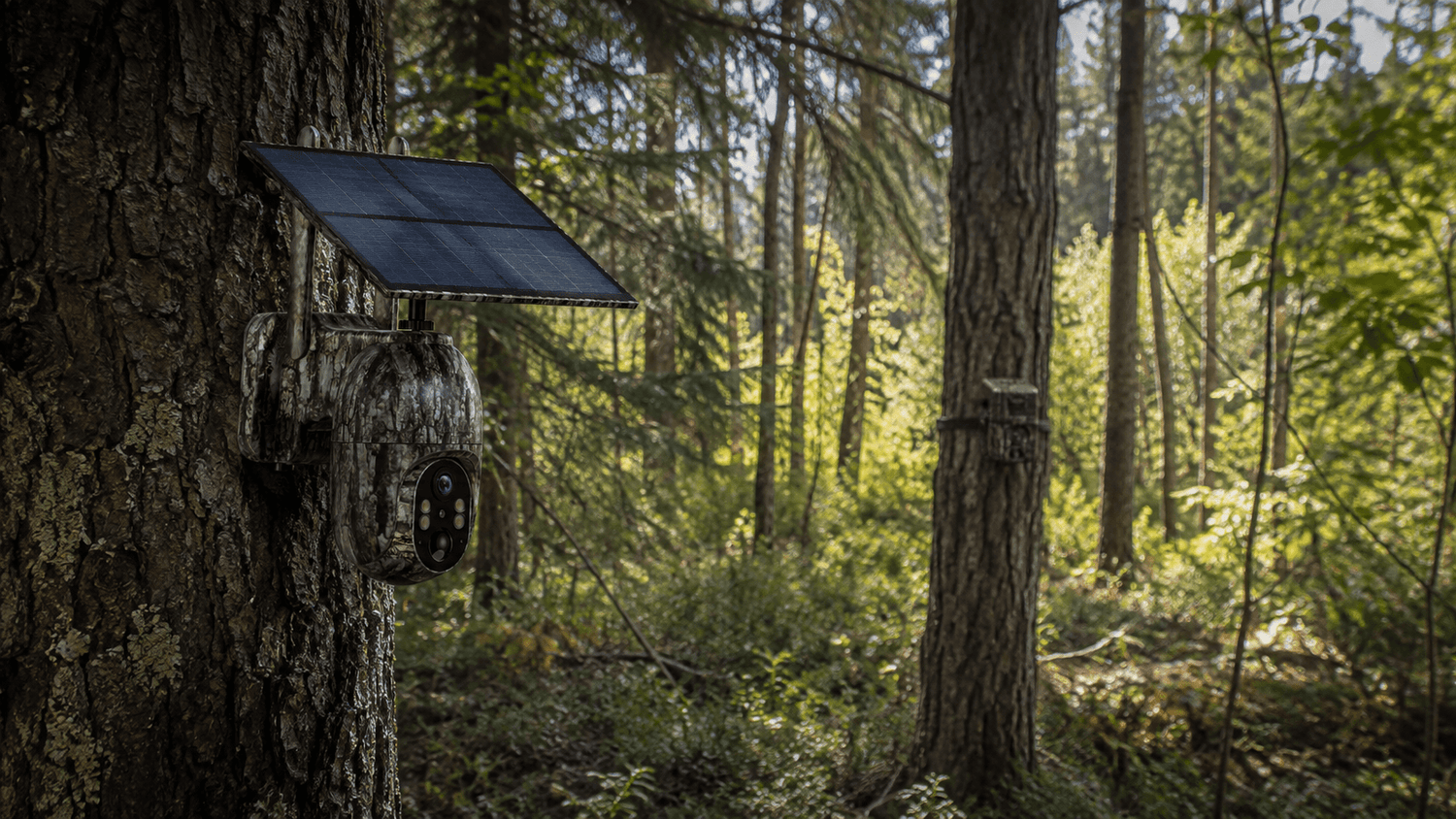
If you are shopping for a trail camera, one of the most important decisions is not the camera resolution or night vision—it is how the camera gets its power.
Should you choose a solar trail camera that can recharge itself during the day, or a traditional battery-powered trail camera that relies on replaceable batteries?
Both options can work well, but they are designed for different situations.
A battery trail camera is often simple, affordable, and easy to install almost anywhere. A solar trail camera, on the other hand, can significantly reduce battery changes and maintenance, making it especially useful for long-term wildlife monitoring, deer scouting, hunting properties, and remote locations.
So, which one is better?
For long-term outdoor monitoring, a solar trail camera is usually the better choice. For short-term scouting or heavily shaded locations, a battery trail camera may be more practical.
In this guide, we will compare solar trail cameras and battery trail cameras based on battery life, maintenance, installation, cost, weather, hunting, and real-world use.
What Is a Solar Trail Camera?
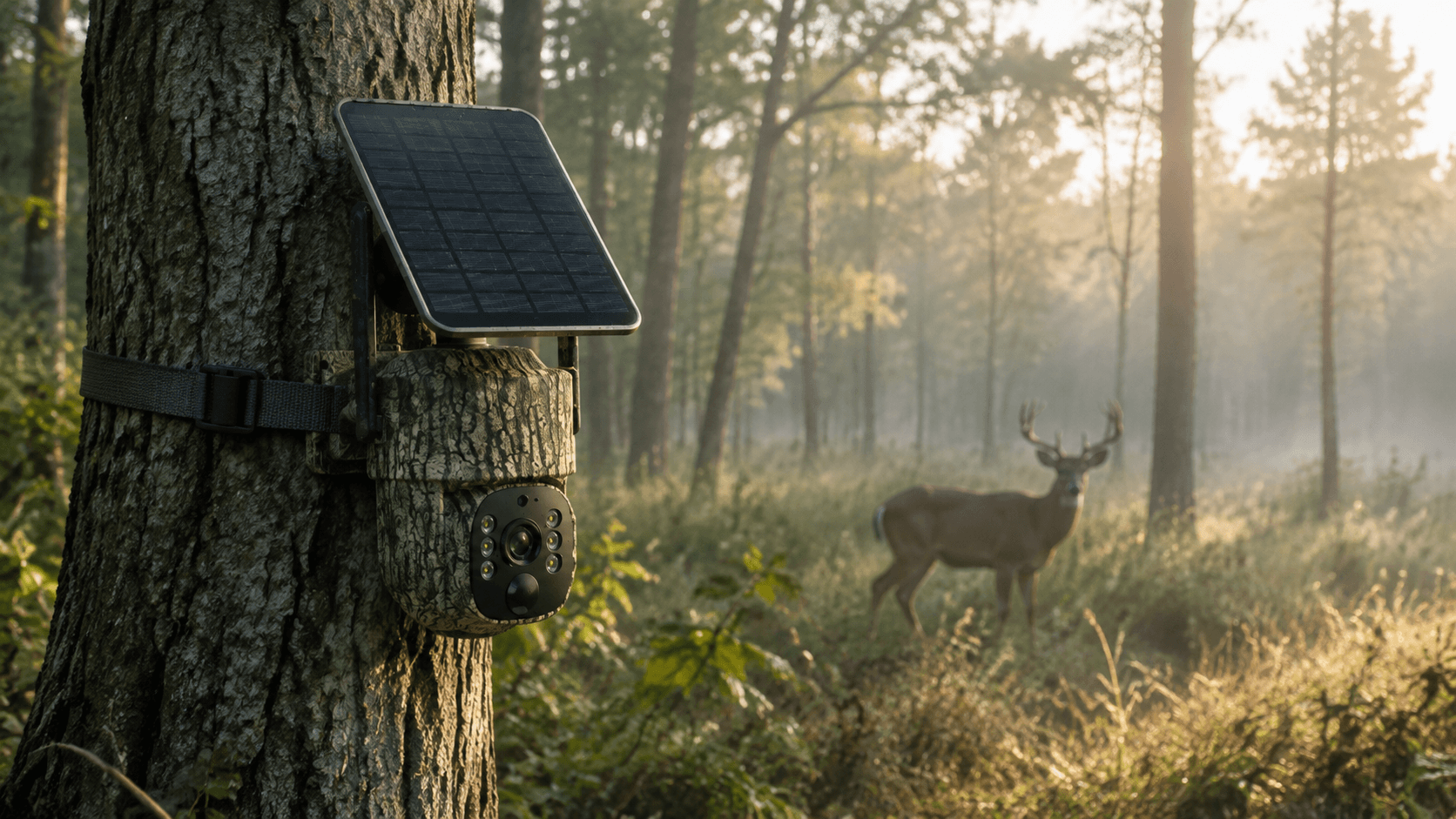
A solar trail camera uses a solar panel to generate electricity during daylight hours. The energy is stored in a rechargeable battery, allowing the camera to continue operating after sunset or during periods without direct sunlight.
Unlike a traditional game camera that depends entirely on disposable or rechargeable batteries, a solar-powered trail camera can continuously replenish its battery whenever sufficient sunlight is available.
This makes solar trail cameras particularly useful for:
- Deer hunting and scouting
- Wildlife monitoring
- Remote property surveillance
- Farms and ranches
- Long-term outdoor observation
- Areas that are difficult to visit regularly
Modern solar game cameras can also combine solar charging with WiFi or 4G LTE connectivity. This is especially useful for cellular trail cameras because the camera can transmit photos and videos remotely without requiring frequent visits to the camera location.

What Is a Battery Trail Camera?
A battery trail camera relies entirely on replaceable or rechargeable batteries.
Most traditional trail cameras use AA batteries, although some newer models use larger rechargeable battery packs.
Battery-powered game cameras remain popular because they are simple to install. You do not need to think about solar panel placement, sunlight direction, or whether the panel is receiving enough light.
Simply install the batteries, mount the camera, configure the settings, and place it in the field.
Battery trail cameras can be especially useful when:
- You only need a camera for a few weeks
- The camera is installed in a heavily shaded forest
- You frequently move your cameras
- You need the lowest possible upfront cost
- Solar charging is difficult in your location
The main disadvantage is simple: when the batteries run out, the camera stops working until you replace or recharge them.

Solar Trail Camera vs Battery Trail Camera: Key Differences
| Feature | Solar Trail Camera | Battery Trail Camera |
|---|---|---|
| Power source | Solar panel + rechargeable battery | Replaceable/rechargeable batteries |
| Long-term operation | Excellent | Good |
| Maintenance | Low | Higher |
| Initial cost | Usually higher | Usually lower |
| Long-term operating cost | Lower | Higher |
| Installation flexibility | Good | Excellent |
| Shaded locations | Less ideal | Excellent |
| Remote monitoring | Excellent when paired with cellular | Depends on model |
| Best for | Long-term monitoring | Short-term or flexible scouting |
Now let's look at each factor in more detail.
1. Battery Life: Solar Trail Camera Wins
Battery life is one of the biggest differences between the two systems.
A traditional battery trail camera consumes stored battery power every time it captures an image, records a video, activates infrared night vision, or transmits data.
How quickly the batteries drain depends on several factors, including:
- Number of triggers
- Video length
- Photo resolution
- Night vision activity
- Cellular transmission
- Temperature
- Network signal strength
A solar-powered trail camera works differently.
During the day, the solar panel can replenish the rechargeable battery. The stored energy can then power the camera at night or during periods of limited sunlight.
This does not mean a solar trail camera will run indefinitely under every condition. Several days of heavy cloud cover, snow, shade, or incorrect panel positioning can reduce charging efficiency.
However, when installed correctly, solar charging can dramatically extend deployment time.
Winner: Solar Trail Camera
2. Maintenance: Solar Cameras Require Less Work
Imagine placing five trail cameras around a large hunting property.
With traditional battery cameras, you may eventually need to visit every camera to check battery levels and replace depleted batteries.
That means:
More driving + more hiking + more maintenance + more disturbance to the area.
A solar-powered trail camera can reduce the frequency of these maintenance visits.
This is especially valuable when cameras are installed deep in the woods, on large hunting properties, or in locations that are difficult to access.
Fewer visits can also help reduce human disturbance around wildlife monitoring locations.
For hunters and wildlife observers who want a set-and-forget trail camera, solar power is a major advantage.
Winner: Solar Trail Camera
3. Initial Cost: Battery Cameras Have the Advantage
A traditional battery-powered trail camera is usually simpler because it does not require a solar charging system.
That can make battery cameras attractive to beginners who want to purchase several cameras without spending too much upfront.
Solar trail cameras generally cost more because the system may include:
- Solar panel
- Rechargeable battery
- Charging circuitry
- Additional power-management hardware
However, the purchase price is only part of the total cost.
If you use a trail camera for several hunting seasons, the cost of repeatedly purchasing batteries can add up.
That is why it is important to consider total ownership cost, rather than simply comparing the initial purchase price.
Winner for upfront cost: Battery Trail Camera
4. Long-Term Cost: Solar Cameras Can Be More Economical
For occasional users, battery cameras can be perfectly affordable.
But if you operate multiple cameras throughout the year, battery costs become more important.
Consider a property with several cameras that need regular battery replacement. Every replacement requires batteries, time, transportation, and a trip to the camera.
A solar-powered trail camera can reduce many of those recurring expenses.
The more frequently and longer you use your camera, the more valuable solar charging becomes.
This is one reason solar game cameras have become increasingly popular for long-term wildlife monitoring and hunting applications.
Winner: Solar Trail Camera
5. Installation Flexibility: Battery Cameras Win
This is where battery-powered trail cameras have a clear advantage.
A battery camera can be installed almost anywhere.
You can place it:
- Under dense tree cover
- Along a shaded trail
- Inside thick woods
- In temporary scouting locations
- In areas with limited direct sunlight
Solar cameras require more planning.
The solar panel should ideally receive enough daylight to recharge the battery effectively. If the panel is completely blocked by trees or facing an unsuitable direction, charging performance can be reduced.
For this reason, a solar trail camera is usually best installed in a location where the camera and solar panel can receive sufficient daylight.
Winner: Battery Trail Camera
6. Hunting and Deer Scouting: Solar Cameras Have a Major Advantage

For serious deer hunters, minimizing unnecessary trips to the camera can be extremely valuable.
Every time you walk into a hunting area, you potentially introduce human scent, noise, and activity.
A solar cellular trail camera can help reduce the need to physically visit the camera simply to check what it has captured.
If the camera also supports cellular connectivity, photos and videos can be transmitted directly to your phone.
That means you can monitor deer movement, check activity patterns, and evaluate a hunting area without constantly pulling the SD card or replacing batteries.
For long-term deer scouting, this combination of solar power + cellular connectivity + remote monitoring can be extremely convenient.
Winner: Solar Cellular Trail Camera
7. What About Winter and Cloudy Weather?
One common question is:
Do solar trail cameras work when there is no sunlight?
Yes.
A solar trail camera does not need sunlight every minute of the day. The solar panel charges a rechargeable battery, and that stored energy can power the camera when sunlight is unavailable.
However, prolonged periods of cloudy weather, heavy snow, or deep shade can reduce the amount of energy generated.
Winter also creates another challenge: low temperatures can affect battery performance.
For locations with extremely limited sunlight, a traditional battery camera with high-quality batteries may still be a better option.
For locations that receive reasonable daylight, however, a solar camera can provide an excellent balance between reliability and low maintenance.
Solar Trail Camera vs Battery Trail Camera: Which One Should You Buy?
The answer depends on how you use your trail camera.
Choose a Solar Trail Camera If:
- You want long-term outdoor monitoring
- Your camera will stay in one location for months
- You want fewer battery changes
- You manage multiple trail cameras
- Your hunting property is large or remote
- You want cellular remote monitoring
- You want to reduce maintenance visits
- Your camera location receives enough sunlight
Choose a Battery Trail Camera If:
- You need a camera for short-term scouting
- You frequently move your camera
- Your location is heavily shaded
- You want the lowest upfront cost
- You do not need solar charging
- You prefer the simplest possible installation
There is no universal winner.
The best trail camera power source depends on your environment, monitoring period, and how often you want to visit the camera.
Why Choose a Voopeak Solar Trail Camera?
Voopeak offers a range of solar-powered trail cameras designed for hunters, wildlife enthusiasts, landowners, and outdoor monitoring.
The current Voopeak solar lineup includes different camera types, including WiFi and 4G cellular models, allowing users to choose a setup based on their connectivity and monitoring needs.
For example, the Voopeak TC27 combines 4G LTE connectivity, solar charging, and 360° PTZ rotation, making it a great choice for users who want flexible, long-term outdoor monitoring with remote access.
Other Voopeak solar trail cameras are designed for different use cases, including WiFi-connected wildlife cameras and cameras with additional battery backup options.
The key advantage is flexibility.
Instead of choosing a trail camera based only on megapixels or video resolution, consider the entire system:
Power + Connectivity + Detection + Night Vision + Storage + Maintenance
A camera that produces excellent images but runs out of power after a few weeks may not be the best choice for a remote hunting property.

Final Verdict: Solar or Battery Trail Camera?
So, which one is better: solar trail camera or battery trail camera?
For most people who plan to keep a camera outdoors for an extended period, a solar trail camera is the better long-term solution.
It can provide:
- Longer operating time
- Fewer battery replacements
- Lower maintenance
- Lower recurring battery costs
- Better suitability for remote locations
- Excellent compatibility with cellular trail cameras
However, battery-powered trail cameras still make sense when you need maximum installation flexibility, are working in deep shade, or only need a camera temporarily.
The best approach is to match the power source to your environment.
Sunny location + long-term monitoring → Solar Trail Camera
Dense shade + short-term scouting → Battery Trail Camera
Remote hunting property + cellular connectivity → Solar Cellular Trail Camera
For hunters and wildlife enthusiasts who want to spend less time maintaining their cameras and more time monitoring the outdoors, a well-designed solar-powered trail camera can be a smart investment.
Explore the Voopeak solar trail camera lineup and choose the power and connectivity setup that fits your outdoor monitoring needs.

Leave a comment
This site is protected by hCaptcha and the hCaptcha Privacy Policy and Terms of Service apply.