
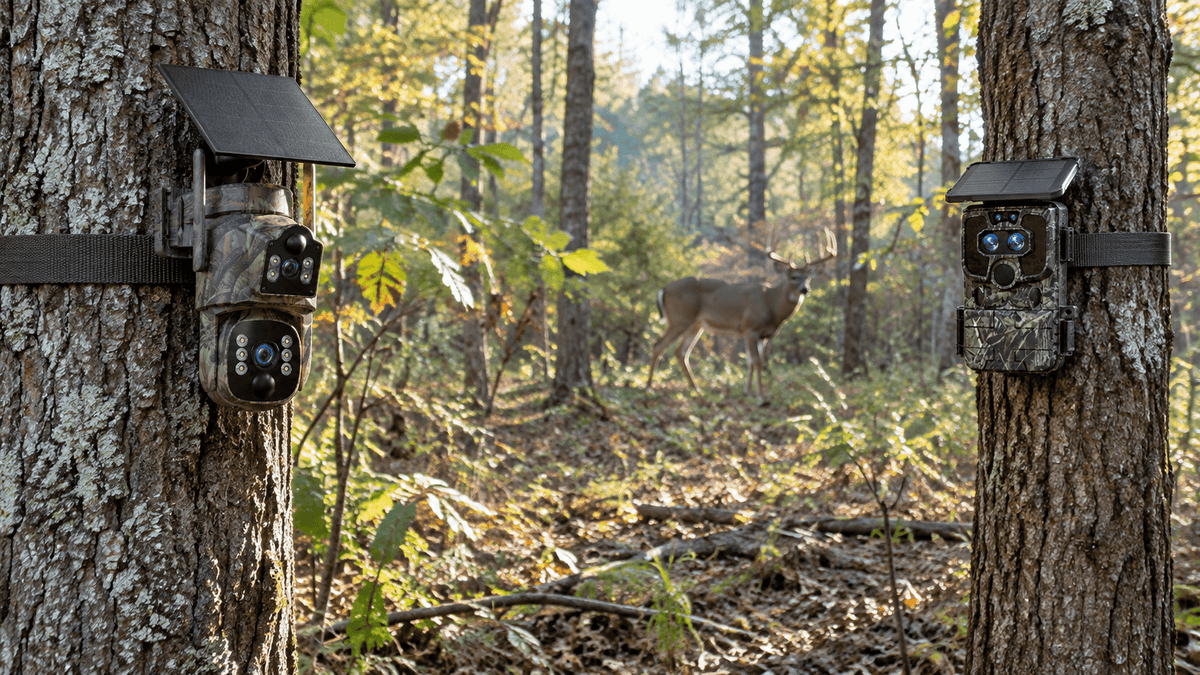
If you're shopping for a trail camera, one of the first questions you may have is: Do trail cameras need WiFi?
The short answer is no. Most trail cameras do not need WiFi to capture photos or record videos. A traditional trail camera can detect motion, take pictures, record video, and save files to a memory card without an internet connection.
However, WiFi becomes important if you want to access your trail camera remotely or transfer photos to your smartphone. For even longer-range remote monitoring, a cellular trail camera uses a mobile network instead of WiFi.
Understanding the difference between WiFi trail cameras and cellular trail cameras can help you choose the right camera for hunting, wildlife monitoring, property surveillance, and outdoor security.
In this guide, we'll explain how trail cameras work without WiFi, how WiFi trail cameras connect to your phone, how cellular trail cameras work, and which type of wireless trail camera is right for your needs.
Do Trail Cameras Need WiFi?
No, trail cameras do not generally need WiFi to work.
A standard trail camera operates independently using a camera sensor, motion detection system, infrared night vision, batteries or solar power, and a memory card.
When an animal enters the camera's detection range, the camera detects movement and automatically captures a photo or video. The files are then stored locally on the memory card.
This means you can install a game camera deep in the woods without a WiFi router or internet connection.
For example, if you place a trail camera along a remote deer trail, it can continue taking pictures of wildlife even when there is no WiFi signal.
The key difference is between recording footage and accessing footage remotely.
A trail camera does not need WiFi to take pictures. However, you need some type of wireless connection if you want the camera to send those pictures to your phone without physically visiting the camera.

Can Trail Cameras Work Without Internet?
Yes. Many trail cameras can work completely offline.
Traditional trail cameras store images and videos directly on an SD card. You can leave the camera in the field for days or weeks and retrieve the card later.
This setup can be useful for hunters and wildlife enthusiasts who don't need real-time notifications.
An offline trail camera can still provide important information such as:
- Deer activity
- Animal movement
- Wildlife patterns
- Feeding activity
- Travel routes
- Daytime and nighttime activity
The main limitation is that you need to physically access the camera to retrieve the stored files.
If you want to check photos from home, you'll need a trail camera with some form of wireless connectivity.
What Is a WiFi Trail Camera?
A WiFi trail camera uses WiFi technology to create a wireless connection between the camera and a compatible smartphone or device.
However, WiFi trail cameras are often misunderstood.
A WiFi trail camera does not necessarily mean that the camera can connect to your home internet from anywhere in the woods.
Many WiFi trail cameras use a short-range wireless connection that allows your smartphone to communicate directly with the camera when you're nearby.
Once connected, you may be able to:
- View photos
- Download videos
- Change camera settings
- Adjust capture modes
- Check battery information
- Manage stored files
This makes a WiFi trail camera convenient when the camera is installed somewhere you can easily reach.
For example, a WiFi trail camera can be useful in a backyard, garden, farm, hunting property, or nearby woodland.
How Far Does WiFi Work on a Trail Camera?
The range of a WiFi trail camera depends on the camera design, antenna, terrain, trees, buildings, and environmental conditions.
Unlike cellular connectivity, WiFi is generally intended for short-range communication.
This means you normally need to be relatively close to the camera to connect your smartphone.
Thick vegetation, hills, buildings, and other obstacles can further reduce the effective range.
Therefore, WiFi trail cameras are generally more suitable when you regularly visit the camera location.
If the camera is several miles away from your home, a WiFi connection alone usually isn't the best solution for remote monitoring.
What Is a Cellular Trail Camera?
A cellular trail camera uses a cellular network to transmit photos and other information.
Instead of relying on a local WiFi connection, the camera communicates through a supported mobile network.
A 4G cellular trail camera can potentially send captured photos directly to a smartphone app or cloud platform, depending on the camera system.
This allows you to monitor wildlife without physically visiting the camera every time you want to check your photos.
Cellular trail cameras are particularly useful for:
- Remote hunting properties
- Deer hunting
- Wildlife monitoring
- Large farms
- Ranches
- Remote cabins
- Outdoor surveillance
- Agricultural properties
The biggest advantage is remote access.
As long as the camera has compatible cellular coverage and sufficient power, you can potentially receive images even when the camera is far away from your home.

Do Cellular Trail Cameras Need WiFi?
No. Cellular trail cameras do not need WiFi.
This is one of the most important differences between WiFi and cellular trail cameras.
A cellular trail camera uses a mobile network instead of your home WiFi network.
However, cellular cameras normally require a compatible SIM card or cellular data plan.
The exact requirements depend on the camera and cellular service provider.
For example, Voopeak cellular trail cameras can use cellular connectivity for remote wildlife monitoring, allowing users to install cameras in locations where there is no traditional WiFi network.
This makes a cellular trail camera especially useful for remote areas where installing a WiFi router would be inconvenient or impossible.
WiFi vs Cellular Trail Camera: What's the Difference?
The easiest way to compare them is to look at how they connect to your phone.
| Feature | WiFi Trail Camera | Cellular Trail Camera |
|---|---|---|
| WiFi required | Usually for local wireless access | No |
| Cellular network | No | Yes |
| Remote monitoring | Usually limited by WiFi range | Yes, with cellular coverage |
| Data plan | Usually not required | Usually required |
| Smartphone access | Typically nearby | Can be remote |
| Best use | Nearby locations | Remote locations |
| Installation | Generally simple | Requires cellular setup |
| Ongoing connectivity cost | Usually lower | May require data plan |
The biggest difference is distance.
WiFi is generally better for short-range access, while cellular connectivity is designed for long-distance communication.
Which Is Better for Hunting?
There isn't one trail camera connection that is right for every hunting situation.
If you hunt on property close to your home and regularly visit the camera, a WiFi trail camera may provide enough convenience.
You can connect to the camera when you're nearby and download your photos without removing the memory card.
However, if your hunting property is far away, a cellular trail camera can reduce the need for frequent trips.
Imagine placing a camera several miles away along a deer trail.
With a traditional SD-card trail camera, you need to physically visit the camera to see what it has captured.
With a cellular trail camera, compatible models can transmit photos remotely, allowing you to monitor deer activity from your smartphone.
This can be particularly useful for monitoring:
- Deer movement
- Food plots
- Bedding areas
- Travel corridors
- Water sources
- Hunting property activity
Remote access can also reduce the amount of human activity around the camera location.

Does a Cellular Trail Camera Need a Data Plan?
In most cases, yes.
Because a cellular trail camera transmits photos through a mobile network, it normally requires cellular data.
The exact cost and data requirements depend on:
- Number of photos
- Video transmission
- Image resolution
- Upload frequency
- Cellular provider
- Data plan
- Camera settings
If a camera sends a large number of high-resolution images or videos, it can use more data.
For this reason, users should consider both the camera's purchase price and the potential ongoing cellular service cost when choosing a cellular trail camera.
Are WiFi Trail Cameras Better for Battery Life?
Connectivity can affect battery consumption, but battery life also depends on many other factors.
A traditional trail camera that only detects motion and saves files locally may consume relatively little power between triggers.
A cellular trail camera needs additional power to communicate with the mobile network and transmit data.
Factors that influence trail camera battery life include:
- Trigger frequency
- Photo resolution
- Video length
- Night vision usage
- Cellular signal strength
- Transmission frequency
- Battery capacity
- Temperature
- Solar charging conditions
For long-term remote monitoring, a solar-powered cellular trail camera can be an attractive option because solar charging can help maintain the battery over extended periods.
However, solar performance depends on sunlight, weather, installation angle, camera usage, and other environmental conditions.

WiFi Trail Cameras vs Cellular Trail Cameras: Which Should You Buy?
Your choice should depend on where you plan to install the camera and how you want to access your photos.
Choose a WiFi trail camera if:
- Your camera is installed relatively close to you.
- You regularly visit the camera.
- You don't need long-distance remote monitoring.
- You want smartphone access when you're nearby.
- You want to avoid a cellular data plan.
- You're monitoring a backyard, garden, farm, or nearby hunting property.
Choose a cellular trail camera if:
- Your camera is installed far from home.
- You want remote photo transmission.
- You want to monitor wildlife from your smartphone.
- You don't have WiFi at the installation location.
- You're monitoring a remote hunting property.
- You want to minimize trips to the camera.
- You have reliable cellular coverage in the area.
Voopeak WiFi and Cellular Trail Cameras
Voopeak offers both WiFi trail cameras and cellular trail cameras, giving users different connectivity options depending on their outdoor monitoring needs.
For users looking for a WiFi trail camera, the Voopeak TC22 provides wireless connectivity along with high-resolution image and video capabilities. It can be a practical option for users who want convenient smartphone access when they are within wireless range.
The Voopeak TC37 is another WiFi trail camera designed for users looking for high-resolution wildlife photos and video.
For remote monitoring, the Voopeak TC32 is a 4G cellular trail camera designed to use cellular connectivity rather than relying on local WiFi.
Voopeak also offers solar-powered cellular trail camera options such as the TC27 and TC39, which are designed for users who want remote monitoring with a more convenient long-term power setup.
When choosing between these models, consider your installation location, cellular coverage, monitoring distance, power source, and whether you need remote access.
Can You Use a Trail Camera Without WiFi?
Absolutely.
A trail camera can work without WiFi if it is designed to store photos and videos locally.
The real question is whether you need remote access.
If you are comfortable visiting the camera and removing the SD card, you don't need WiFi or cellular service.
If you want to connect your phone when you're nearby, a WiFi trail camera can provide a convenient solution.
If you want to receive photos while you're hundreds of miles away, a cellular trail camera is generally the more appropriate type of wireless trail camera.
Final Answer: Do Trail Cameras Need WiFi?
No, trail cameras do not need WiFi to capture photos or videos.
Traditional trail cameras can work completely offline and save footage to an SD card.
WiFi trail cameras provide convenient short-range smartphone connectivity, while cellular trail cameras use a mobile network for remote monitoring.
The simplest way to choose is to ask yourself:
Do I need to access my trail camera remotely?
If the answer is no, a traditional trail camera or WiFi trail camera may be sufficient.
If you want to monitor wildlife remotely and receive photos without visiting the camera, a cellular trail camera may be the better connectivity option.
For remote hunting, wildlife monitoring, and long-term outdoor surveillance, understanding the difference between WiFi vs cellular trail cameras can help you choose a camera that matches your location and monitoring needs.


Hinterlasse einen Kommentar
Diese Website ist durch hCaptcha geschützt und es gelten die allgemeinen Geschäftsbedingungen und Datenschutzbestimmungen von hCaptcha.