
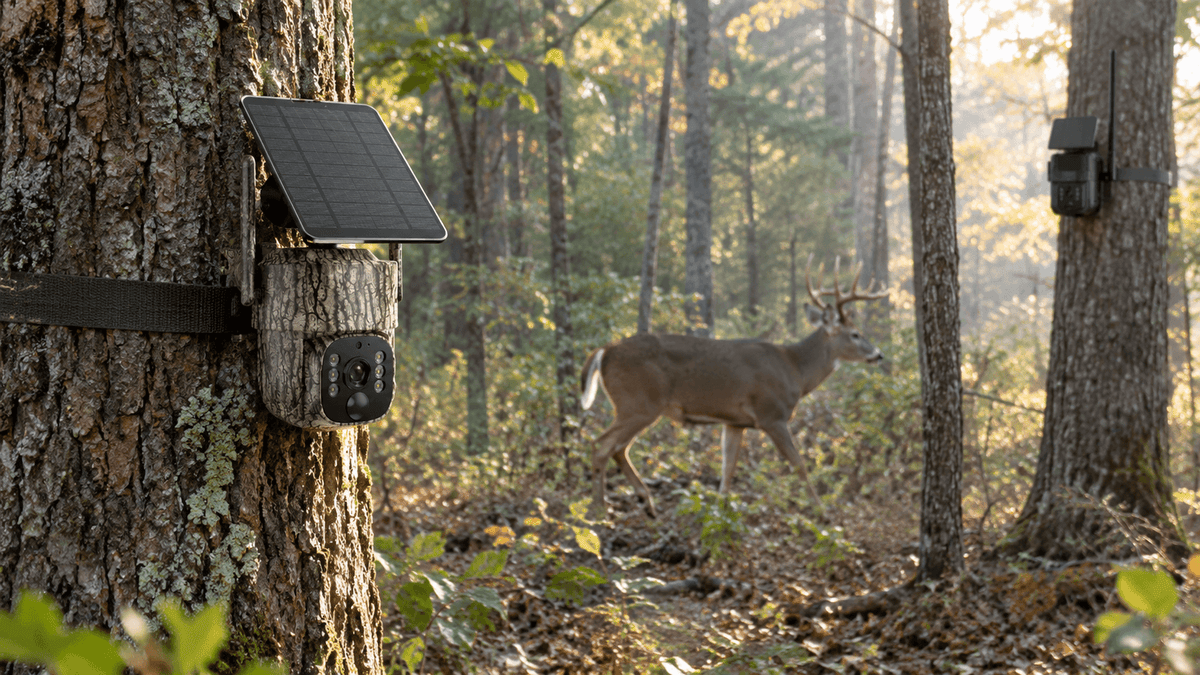
Cellular trail cameras have changed the way hunters and wildlife enthusiasts monitor remote areas. Instead of visiting a camera location every few days to check an SD card, a cellular trail camera can send photos and videos directly to your phone over a cellular network.
Two approaches are especially common today: traditional fixed-position cellular trail cameras and more flexible cameras designed for remote monitoring and control.
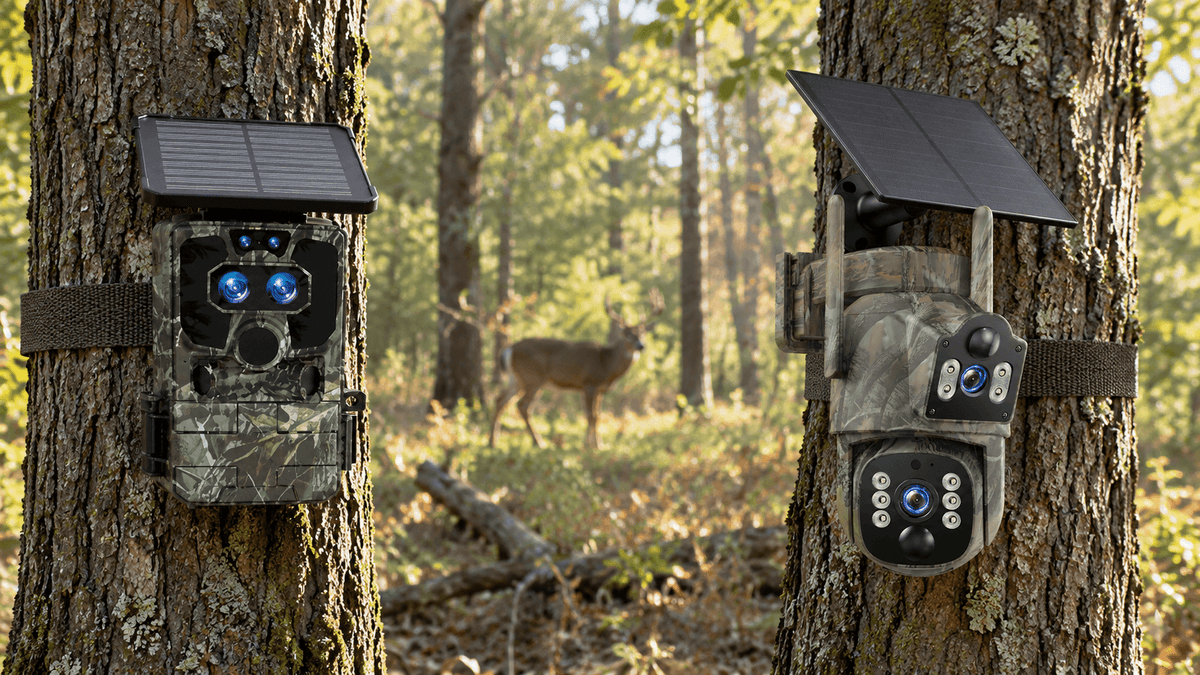
In this comparison, we’ll look at the Voopeak TC32 alongside the Tactacam REVEAL X 2.0 and X 3.0. Rather than focusing only on image resolution or individual specifications, this guide looks at the practical differences that matter when choosing a cellular trail camera—including connectivity, power, PTZ control, live viewing, night vision, and everyday use.
The biggest difference is simple:
REVEAL X cameras are designed around traditional fixed-position scouting, while the Voopeak TC32 combines cellular connectivity with solar power and remote PTZ control for a more flexible monitoring setup.
What Is a Cellular Trail Camera?
A cellular trail camera uses a cellular network to transmit captured images or videos without requiring a local Wi-Fi connection.
This makes cellular cameras particularly useful for locations where there is no Wi-Fi, such as:
- Remote hunting properties
- Wildlife observation areas
- Large farms and ranches
- Forest trails
- Food plots
- Cabins and outbuildings
- Rural properties
Once the camera has cellular coverage and power, you can monitor activity remotely through a compatible mobile app.
Both the Voopeak TC32 and Tactacam REVEAL X series are designed for this type of remote cellular monitoring.
The difference is what you can do after the camera has been installed.
Voopeak TC32 vs. Tactacam REVEAL X 2.0 & X 3.0 at a Glance
| Feature | Voopeak TC32 | Tactacam REVEAL X 2.0 | Tactacam REVEAL X 3.0 |
|---|---|---|---|
| Cellular Connectivity | 4G LTE | 4G LTE | 4G LTE |
| Wi-Fi Required at Camera | No | No | No |
| Camera Movement | Remote PTZ | Fixed | Fixed |
| Pan | Up to 355° | — | — |
| Tilt | Up to 90° | — | — |
| Power | Rechargeable battery + solar panel | 12 AA batteries | 12 AA batteries |
| Solar Power | Integrated solar setup | Optional external solution | Optional external solution |
| Live View | Yes | — | Yes |
| Remote Camera Positioning | Yes | No | No motorized PTZ |
| Night Vision | Infrared | Low-glow IR | Low-glow IR |
| Best For | Flexible remote monitoring | Traditional trail scouting | Traditional scouting + advanced features |
Specifications and features can vary by model and firmware, so always check the current manufacturer's specifications before purchasing.
1. The Biggest Difference: Fixed Camera vs. Remote PTZ
The most important difference between these cameras isn't necessarily the megapixel count.
It's camera movement.
Traditional trail cameras are generally installed in one position. Once the camera is mounted to a tree, it continues monitoring the area in front of the lens.
The Voopeak TC32 takes a different approach.
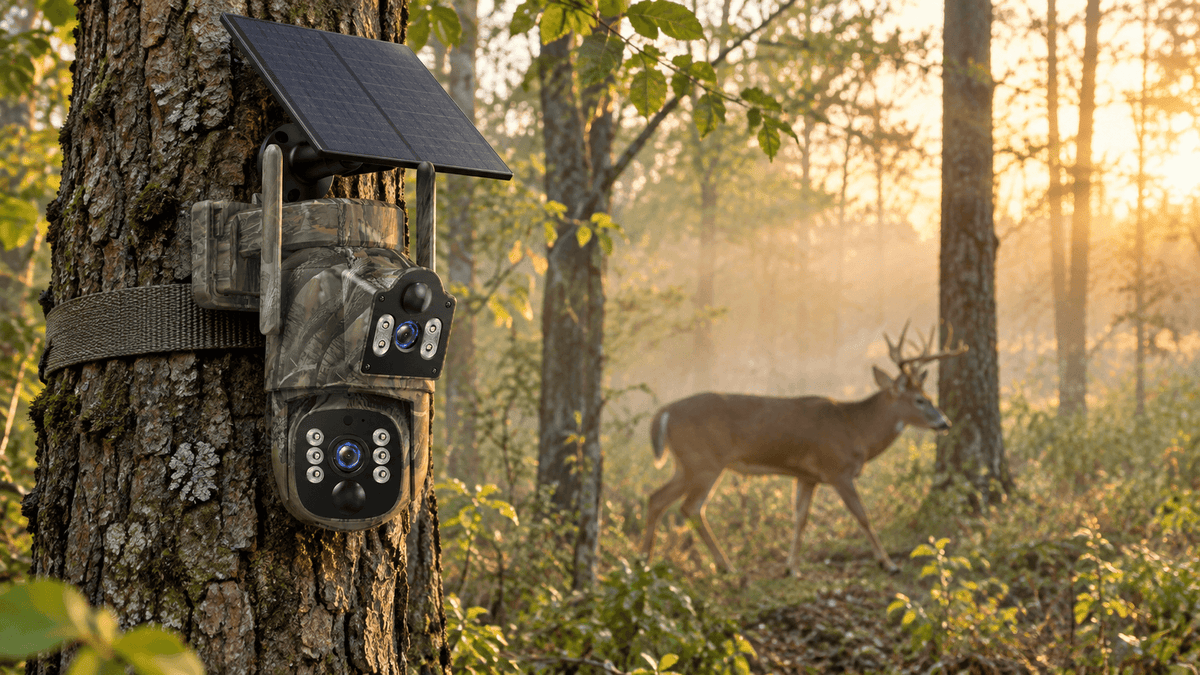
It features PTZ control, allowing the camera to pan horizontally and tilt vertically through remote control.
The TC32 can rotate up to approximately 355° horizontally and 90° vertically, giving you a much wider range of coverage than a traditional fixed-position camera.
Why does PTZ matter?
Imagine installing a camera near a large property.
With a traditional fixed trail camera, you need to carefully choose the direction before leaving.
If deer begin appearing 20 or 30 feet to the side of the original viewing area, the camera can't physically turn toward them.
With a PTZ camera, the situation is different.
You can remotely adjust the camera's viewing direction when you need to monitor another area.
This can be especially useful when:
- Wildlife changes its movement pattern
- You want to monitor different sections of a property
- You need to check an unfamiliar area
- You want to observe a larger outdoor space
- You don't want to physically revisit the camera
This is also where the REVEAL X 3.0's Live Camera Aiming should be distinguished from PTZ.
Live Camera Aiming can help you see and adjust the camera during setup, but it is not the same as having a motorized camera that can remotely pan and tilt after installation.
In simple terms:
Traditional trail camera: Install it → Point it → Leave it
TC32 PTZ camera: Install it → Monitor remotely → Change the viewing direction when needed

2. Power: Rechargeable Solar vs. Traditional AA Batteries
Power is another major consideration for a trail camera that will be installed outdoors for extended periods.
The Tactacam REVEAL X 2.0 and X 3.0 use 12 AA batteries as their primary battery configuration.
External power and solar accessories can also be used with the REVEAL ecosystem, providing additional options for longer deployments.
The Voopeak TC32, on the other hand, combines a rechargeable battery with a 3W solar panel as part of its setup.
This allows the camera to use solar energy during the day while storing energy in the rechargeable battery.
Why is this useful?
For cameras installed in remote areas, reducing the frequency of battery changes can make maintenance easier.
A solar-assisted system can be particularly useful for:
- Long-term wildlife monitoring
- Remote hunting locations
- Farm and ranch surveillance
- Areas that are difficult to access
- Seasonal wildlife observation
Of course, solar performance depends on factors such as sunlight, weather, camera activity, and installation angle.
So the key difference isn't simply “solar vs. no solar.”
It's more accurately:
Traditional battery-powered camera with optional external power solutions vs. a camera designed around an integrated rechargeable battery + solar setup.

3. Cellular Connectivity Without Local Wi-Fi
Both the TC32 and REVEAL X cameras are designed for cellular connectivity.
That means you don't need to install a Wi-Fi router next to the camera.
This is one of the biggest advantages of cellular trail cameras.
For example, a hunting property may have excellent cellular coverage but no Wi-Fi infrastructure.
A cellular camera can still send captured footage to your phone.
The Voopeak TC32 uses 4G LTE cellular connectivity, making it suitable for remote outdoor locations where compatible cellular service is available.
The REVEAL X 2.0 and X 3.0 also use cellular networks to transmit captured content.
This makes both systems fundamentally different from standard Wi-Fi trail cameras.
4. Live View and Remote Monitoring
Another important difference is how you interact with the camera after installation.
Traditional trail cameras are primarily designed to detect movement, capture photos or videos, and transmit those files.
The TC32 adds another layer of remote interaction.
Its 2.5K live view allows users to check what the camera is seeing without physically traveling to the camera location.
Combined with PTZ functionality, this creates a more interactive monitoring experience.
Instead of simply asking:
“What did the camera capture?”
you can also ask:
“What is the camera seeing right now?”
And when the viewing direction needs to change, the PTZ mechanism provides additional flexibility.
This can be useful when monitoring an area where wildlife movement is unpredictable.

5. Night Vision Comparison
Night vision is essential for wildlife monitoring because many animals are most active after sunset.
The Tactacam REVEAL X 2.0 and X 3.0 use low-glow infrared illumination for nighttime image capture.
The Voopeak TC32 also uses infrared night vision for low-light monitoring.
For hunters and wildlife observers, infrared illumination can help the camera capture nighttime activity without using visible white light like a standard outdoor security floodlight.
When comparing night vision, it's important to look beyond the basic label.
Actual nighttime performance can depend on:
- IR illumination
- Sensor sensitivity
- Distance to the subject
- Ambient lighting
- Weather conditions
- Animal movement
- Camera positioning
For wildlife applications, camera placement is often just as important as the advertised night-vision specification.
6. Which Camera Is Better for Different Outdoor Scenarios?
There isn't one camera design that fits every property.
The better choice depends on how you plan to use the camera.
Choose a traditional REVEAL X-style setup if:
You mainly want a straightforward cellular trail camera for monitoring a known location.
For example:
- A deer trail
- A food plot
- A feeder
- A fixed game crossing
- A specific entrance or path
If the animals consistently pass through one area, a fixed camera can be perfectly practical.
Once you've found the right angle, you may not need to move the camera frequently.
Consider the TC32 if:
You want more flexibility after installation.
The TC32 can be particularly useful when:
- Wildlife moves across a larger area
- You want to monitor multiple directions
- The best viewing angle changes over time
- The camera is installed in a difficult-to-access location
- You want remote live viewing
- You prefer solar-assisted power
- You want to adjust the viewing direction without physically visiting the camera
This makes the TC32 more than a traditional trail camera.
It works more like a remote outdoor monitoring camera designed for wildlife environments.
7. Installation and Maintenance
Installation strategy is important for both systems.
With a traditional fixed trail camera, the most important step is choosing the correct direction before leaving the property.
You should consider:
- Animal travel routes
- Sun direction
- Background vegetation
- Camera height
- Trigger area
- Potential obstructions
The TC32 still requires careful installation, but PTZ functionality gives you more flexibility after installation.
For solar operation, the solar panel should also be positioned where it can receive sufficient sunlight.
A clear view of the sky and an appropriate panel angle can help improve solar charging performance.
8. Voopeak TC32 vs. REVEAL X: Which Approach Fits Your Needs?
The easiest way to think about these cameras is by their overall design philosophy.
Tactacam REVEAL X
The REVEAL X 2.0 and X 3.0 follow the familiar trail-camera concept:
Install it. Point it. Scout remotely.
They are well suited to users who already know where they want to monitor wildlife and primarily need cellular image and video transmission.
Voopeak TC32
The TC32 expands the concept:
Install it. Power it with solar. Watch remotely. Move the camera remotely.
Its combination of 4G connectivity, rechargeable battery, solar power, live view, and PTZ control is designed for situations where flexibility is more important.
Neither approach is automatically right for every property.
A fixed camera can be exactly what you need when monitoring a single, predictable trail.
A remotely controlled PTZ camera becomes more useful when you want to monitor a broader or changing area without repeatedly visiting the installation site.

Final Thoughts
When comparing the Voopeak TC32 vs. Tactacam REVEAL X 2.0 and X 3.0, the most meaningful difference isn't simply the camera resolution.
It's how much control you have after installation.
The REVEAL X series represents the traditional cellular trail camera approach: mount the camera, point it toward your target area, and receive wildlife images and videos remotely.
The Voopeak TC32 adds more flexibility with 4G cellular connectivity, solar-assisted rechargeable power, 2.5K live view, and remote PTZ control.
For a single, predictable wildlife trail, a traditional fixed cellular camera may be all you need.
For larger properties, changing wildlife patterns, or situations where you want to remotely check and change the viewing direction, the TC32 offers a different way to approach remote wildlife monitoring.
Ultimately, the right cellular trail camera depends on your property, wildlife activity, power conditions, and how much control you want after installation.

Hinterlasse einen Kommentar
Diese Website ist durch hCaptcha geschützt und es gelten die allgemeinen Geschäftsbedingungen und Datenschutzbestimmungen von hCaptcha.